
Heat Stress in Poultry Cause, consequences and solutions.
Heat stress is a major challenge in poultry production, with immediate effects on feed intake and performance. As temperature rises, birds reduce their feed consumption, leading to losses in growth, egg production and flock uniformity. Is often the first visible sign of heat stress. Anticipating and mitigating its impact is therefore essential to maintain performance under hot conditions.
Temperatures and limits

When it is too hot and the air is humid, poultry struggle to regulate their body temperature.
Animal reaction
Less activity
Less feed intake
Inflamation
Oxidative stress
The body is out of balance: rapid breathing, impaired energy production,… Animal performance and building productivity decrease.
Effects of heat stress
-10%
in laying rate
-15%
of live weight
Animals are less efficient, more expensive to rear and more suceptible to diseases, resulting in significant economic losses.
More informationy on heat stress
Why is heat stress such a major challenge in poultry ?
Heat stress is one of the major challenges in modern poultry production, particularly in regions exposed to high temperatures or prolonged heat periods. Poultry have a limited thermoregulation capacity, making them highly sensitive to increases in ambient temperature.
When temperature rises, the animal’s response is rapid: appetite decreases in order to reduce metabolic heat production. This reduction in feed intake is often the first visible indicator of heat stress and typically occurs before any measurable decline in animal performance.
In both broilers and layers, the impact of heat stress is immediate, affecting growth rate, feed efficiency, egg production and flock uniformity. Without an adapted nutritional and management strategy, these effects can persist and lead to significant economic losses.
How do the biological mechanisms of heat stress work?
Behavioral changes
Under high temperature conditions, poultry feeding behaviour is significantly altered. Feeding activity is reduced, as birds voluntarily limit feed intake to decrease internal heat production. Feeding patterns also change, with shorter and more irregular meals, often concentrated during cooler periods of the day.
At the same time, water consumption increases sharply, becoming the primary means of thermoregulation, often at the expense of feed intake.
Physiological consequences
Heat stress leads to increased oxidative stress, resulting from an imbalance between free radical production and the bird’s antioxidant defense systems. This situation can negatively affect digestive functions and the animal’s ability to efficiently utilise nutrients.
Impaired digestive efficiency, combined with reduced feed intake, results in poorer nutrient utilisation and increased performance variability within the flock.
What are the nutritional levers to mitigate heat stress?
Supporting feed intake
The first nutritional lever when facing heat stress is to preserve feed intake. Maintaining feed attractiveness is essential to encourage voluntary intake, even under challenging environmental conditions. A more consistent feed intake helps limit sudden performance drops and supports overall production stability.
Supporting adaptation to stress
Beyond feed intake, specific nutritional approaches aim to support the physiological balance of poultry exposed to heat stress. These strategies help improve the animal’s ability to adapt, reduce the negative impact of stress on digestive and metabolic functions, and limit performance variability between birds.
Every challenge has its solution!
Our solutions are suited to the production of broilers, ducks, turkeys and guineafowl, as well as laying hens.

Sensory solution to improve performance by helping animals adapt well tostressful situations
Increase feed intake under heat stress
- Maintains feed intake under heat stress
- Improves drinking behavior
- Keeping performance up to the end of the cycle.
Recovery of 50%
of the drop of feed intake

Natural antioxidant
from grape seed and grape
skin extract
Reducing oxidative stress under heat stress
- Bind free radicals
- Enhance growth performance
- Improve egg and meat quality
ORAC
Value >11 000 μmolTE/g

Highly bioavailable curcumin with its unique mix of actives combined to an advanced galenic technology
Reducing sub-inflammation under heat stress
- Reduce inflammation
- Increase performance
- Reduce late mortality
+74%
more Interleukin 10
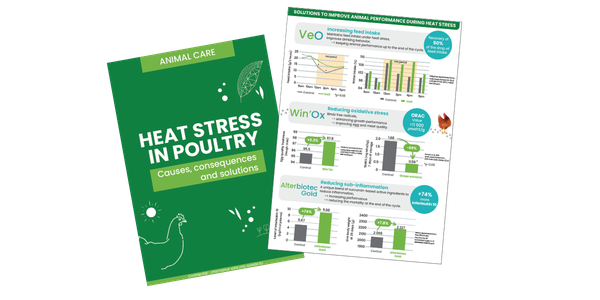
Ready to cope with heat stress
Discover our brochure with all the information to combate heat stress
Need help choosing the right product for you?
Our team is available to discuss the matter with you.
Latam Manager
Brazil
Sales Director
DACH
Europe
Asia
France
Latin America