

The importance of early life stages in aquaculture for stress management
Within the shrimp farming industry, regardless of region or production system, one fundamental rule is universally recognized: the more robust the juvenile animal, the better its performance at subsequent production stages.
This rule holds true throughout the entire production cycle — a healthy larva produces a strong post-larva (with good health, growth rate, and robustness); a “good post-larva” results in a strong juvenile; a “good juvenile” becomes a “good grow-out animal”; and the same principle continues to apply all the way to broodstock and nauplii.
Critical stages in shrimp development
The early stages are regarded as critical for the animal’s development. This is due to the biological and physiological changes occurring at these stages, such as the formation of the immune, digestive, and nervous systems, which will determine the animal’s ability to cope with challenges throughout its production cycle.
Shrimp, in particular — being decapod crustaceans — undergo several moulting phases during which they are especially vulnerable. This fragility stems from the high energy demand of the moulting process, the stress it induces, and the temporary absence of the exoskeleton, which normally serves as their primary defence barrier against pathogens.
A reproductive strategy that increases mortality
Moreover, shrimp follow an “r-strategy” reproductive pattern, meaning that they produce an extremely high number of offspring but provide no parental care. Consequently, a low survival rate is expected among larvae, largely due to predation, disease, parasites, and other environmental factors.
Conversely, species with a “K” reproductive strategy—such as birds or mammals—have low fecundity but provide parental care, enabling their offspring to increase their chances of survival.
Because shrimp follow an “r-strategy”, juvenile mortality rates in aquaculture are high, and productivity is further affected by genotypic variation, which results in differences in growth, size, immunity, and hierarchical behaviour. Consequently, larval producers face significant economic losses.
Technological advances in hatcheries and nurseries
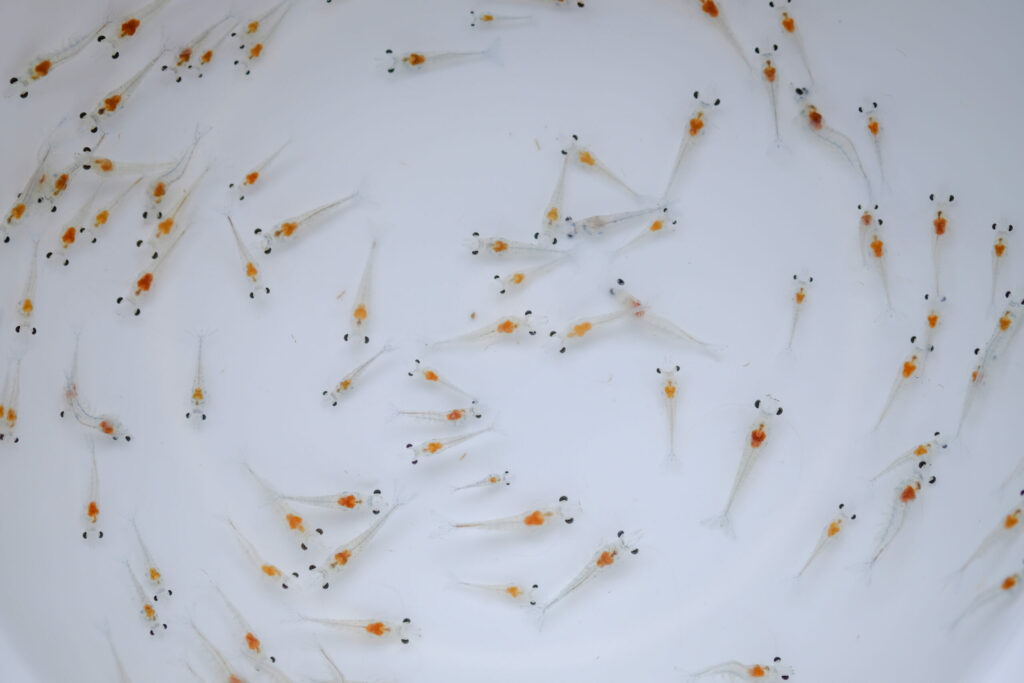
After several decades of technological progress, multiple strategies are now available for larval management in hatcheries and nurseries, including:
- diversified feeding protocols (using Artemia, algae, or extruded micro-feeds);
- the use of probiotics, bioremediators, organic acids, or phytobiotics;
- optimisation of production management (transport, sampling, and room organisation).
Given the fragility of larvae, a major focus in hatcheries is placed on immunity, disease and pathogen management, and nutritional improvements to support growth and health.
Stress in shrimp production: an often underestimated factor
Despite all the innovations in nutrition and disease prevention, many hatcheries still face issues of poor growth and low survival towards the end of production, reducing system productivity and profitability, and preventing them from reaching their full potential.
Among the various contributing factors, one of the most underestimated aspects of management is stress generation. Stress is the response of an organism to an unexpected, unfamiliar, and uncontrollable external stimulus. In responding to stress, the organism mobilises its metabolism to produce and consume energy. This diversion of energy towards stress response leaves the organism unable to meet other essential needs such as maintaining homeostasis, growth, and immune function.
As a result, animals become more fragile due to a lack of energy and are more prone to disease, fatigue, and ultimately, mortality—especially if they do not consume enough feed to generate the energy required to cope with the situation.
The link between stress and feeding in hatcheries
Managing feed intake and stress is therefore essential for any production system seeking high survival rates.
These two parameters, which may initially appear unrelated, are in fact governed by the same biological pathway.
Stress, as a brain-mediated signal triggering a physiological response, shares the same hormonal signalling pathway as appetite. Therefore, at the brain level, these two messages cannot be activated or combined simultaneously: an animal experiencing stress does not receive appetite signals, and conversely, an animal with an active appetite at a given moment is less likely to become stressed.
This link exists in both humans and animals, and even though shrimp do not possess a highly developed brain like vertebrates, the same principle applies to them.
It is therefore crucial to promote feed intake in shrimp during hatchery and nursery phases, while also implementing strategies to reduce stress during operations. Larvae and juveniles that feed well and develop robustness will be of higher quality, facilitating smoother progression through the rest of the production cycle up to harvest.
Stress management — a key driver of performance in shrimp hatcheries and nurseries
The success of a shrimp hatchery or nursery depends on a delicate balance between nutrition, biosecurity, and stress management. Beyond technical protocols and nutritional innovations, reducing stress in hatcheries emerges as a decisive lever for strengthening larval and juvenile robustness, optimising growth, and ensuring consistent performance throughout the production cycle.
Investing in an integrated approach—combining stress prevention, appetite stimulation, and close monitoring of rearing conditions—enables producers to achieve higher survival rates, sustainable profitability, and consistent batch quality.
SOURCES:
•Aparicio-Simón, Benjamín, Piñón, Manuel, Racotta, Radu, & Racotta, Ilie S.. (2018). Neuroendocrine and metabolic responses of Pacific whiteleg shrimp Penaeus vannamei exposed to hypoxia stress. Latin american journal of aquatic research, 46(2), 364-376. Fingerman, M., Nagabhushanam, R., 1992. Control of the release of crustacean hormones by neuroregulators. Comp. Biochem. Physiol., C 102, 343–352.
•Kulczy•Lorenzon, S., Edomi, P., Giulianini, P.G., Mettulio, R., Ferrero, E.A., 2005. Role of biogenic amines and cHH in the crustacean hyperglycemic stress response. J. Exp. Biol. 208, 3341–3347
•Selye, H. (1956). The stress of life. McGraw-Hill.